





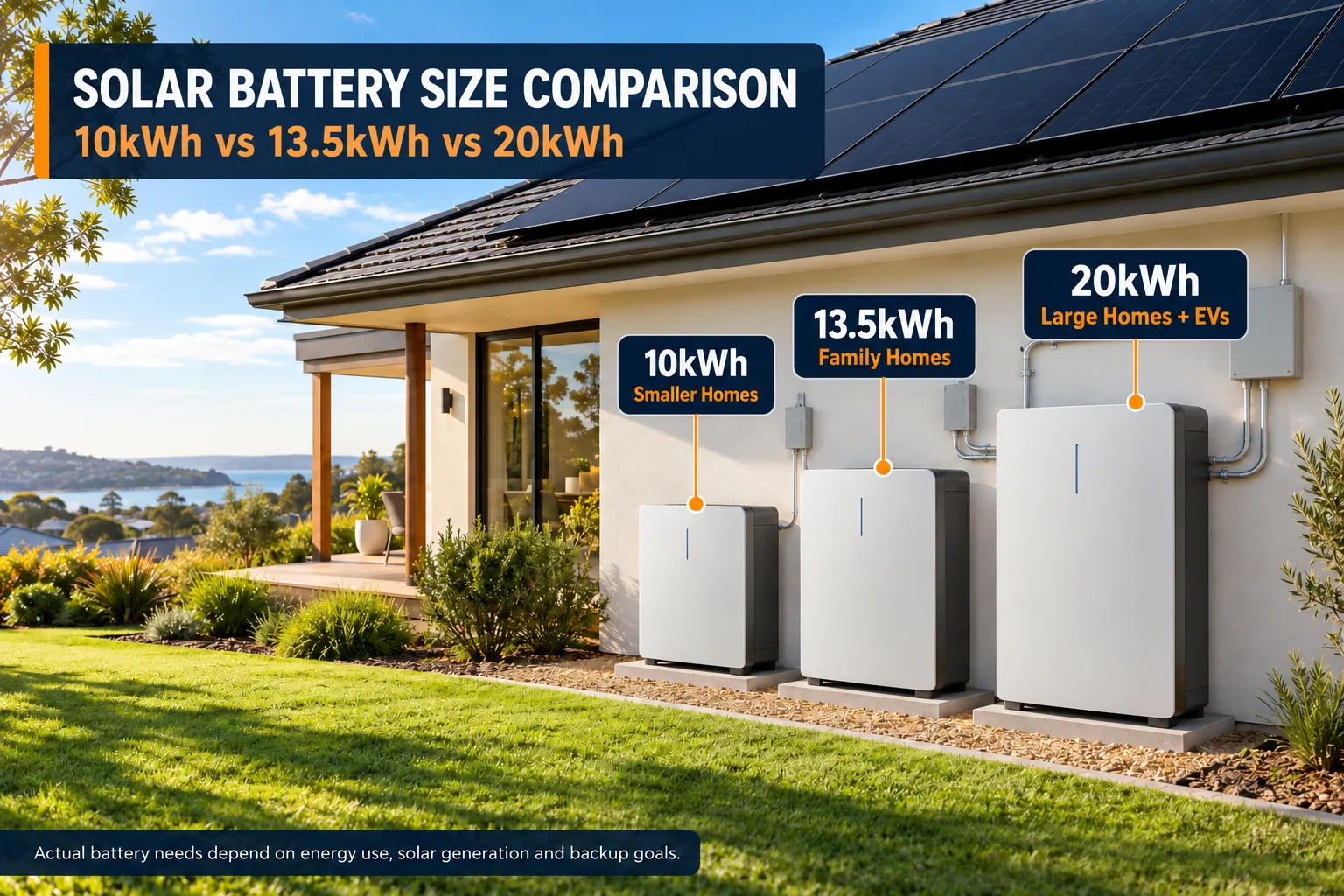
Choosing between a 10kWh, 13.5kWh, and 20kWh solar battery is one of the biggest decisions Australian homeowners face once they decide to add battery storage to their solar system. Get the size right and you cut your electricity bill, gain reliable backup power, and make the most of the federal battery rebate. Get it wrong and you either pay for storage capacity you never use, or you run out of stored solar power before the sun comes back up.
This guide compares 10kWh, 13.5kWh, and 20kWh solar batteries on price, household suitability, and the current rebate rules, so you can choose confidently rather than guessing.
How Much Solar Battery Storage Do You Actually Need?
Before comparing battery sizes, it helps to understand your own energy use. Most Australian households use somewhere between 15kWh and 20kWh of electricity per day, with a large share of that consumed in the evening after the sun has set, which is exactly when a home battery is meant to take over from the grid. Your ideal battery size depends on a combination of factors:
- Number of people in the household and typical evening electricity use
- The size of your solar system, since a bigger battery is only useful if your panels can refill it the next day
- Whether you run high draw appliances such as ducted air conditioning, an electric vehicle charger, or a pool pump
- Whether you want partial backup for essential circuits or whole home backup during a blackout
- Your budget once the current federal rebate is applied
With that in mind, here is how the three most common home battery sizes on the Australian market compare.
10kWh Solar Batteries: Compact and Cost Effective
A 10kWh solar battery is the entry point for most households that want genuine evening and overnight coverage rather than just a token amount of storage. Batteries in this bracket, such as a BYD Battery Box Premium HVM 11.0 or a stacked Enphase IQ Battery 5P system, typically deliver around 10 to 11kWh of usable capacity.
Who a 10kWh battery suits
- One to three person households with moderate evening electricity use
- Homes with a 6.6kW to 10kW solar system
- Homeowners who want to reduce grid reliance without paying for capacity they will not use
Pros and cons
- Lower upfront cost than 13.5kWh or 20kWh systems, generally installed for roughly $9,000 to $13,000 before the federal rebate
- Falls entirely within the full rebate tier, since it sits under the 14kWh threshold
- May not fully cover a high use household through to sunrise on winter evenings or during extended cloudy periods
13.5kWh Solar Batteries: The Popular Middle Ground
The 13.5kWh capacity point is effectively the industry standard battery size in Australia, largely because it matches the fixed capacity of the Tesla Powerwall 3, one of the most widely installed home batteries in the country. Competing products such as the BYD HVM 13.8 and Sungrow SBR128 sit in a similar range.
Who a 13.5kWh battery suits
- Three to five person households with average to above average evening electricity use
- Homes with a 6.6kW to 10kW solar array generating enough surplus to refill the battery daily
- Households that want strong whole home backup capability during blackouts, since many 13.5kWh units include a high output built in inverter
Pros and cons
- Sits just under the 14kWh rebate threshold, so it still qualifies for the full STC factor on every kilowatt hour of usable capacity
- Typically installed for roughly $11,000 to $16,000 before the rebate, depending on brand and inverter configuration
- A noticeable jump in upfront cost compared to a 10kWh system, so it is worth confirming your daily usage genuinely justifies the extra 3 to 4kWh
20kWh Solar Batteries: Built for Bigger Homes and Bigger Loads
Once a household needs more than around 14kWh of nightly storage, whether due to a larger family, an all electric home, an EV charged overnight, or a strong desire for multi day blackout resilience, a 20kWh battery system becomes worth considering. Products in this range include the Sungrow SBH 20kWh, GoodWe modular stacks, and scalable platforms such as the Sigenergy SigenStor.
Who a 20kWh battery suits
- Larger households or homes that have gone fully electric, including induction cooktops and electric hot water
- Homes with 10kW or larger solar systems that can realistically recharge a bigger battery each day
- Households prioritising extended backup during outages, or planning to add an EV charger in the near future
Pros and cons
- Substantial storage and backup capacity, typically installed for roughly $15,000 to $19,000 before the rebate
- Only the first 14kWh of capacity earns the full rebate rate under the current rules, with a reduced rate applying to the remaining capacity, explained in detail below
- Only worthwhile if your solar array and daily usage pattern can actually put the extra capacity to work
Quick Comparison: 10kWh vs 13.5kWh vs 20kWh
| Battery Size | Usable Capacity | Best Suited To | Typical Installed Price* | Rebate Tier (from 1 May 2026) |
|---|---|---|---|---|
| 10kWh | Approx. 9.5 to 11kWh | 1 to 3 person households, 6.6kW to 10kW solar | $9,000 to $13,000 | Full STC factor (under 14kWh) |
| 13.5kWh | Approx. 13 to 13.5kWh | 3 to 5 person households, 6.6kW to 10kW solar | $11,000 to $16,000 | Full STC factor (under 14kWh) |
| 20kWh | Approx. 19 to 20kWh | Large or all-electric homes, EV owners, 10kW+ solar | $15,000 to $19,000 | Full factor to 14kWh, reduced factor from 14 to 20kWh |
*Prices are indicative, installed, and before any federal or state rebate is applied. Actual pricing depends on brand, inverter compatibility, installer, and your location.
How the 2026 Cheaper Home Batteries Program Affects Your Choice
Battery pricing in Australia cannot be discussed without factoring in the federal Cheaper Home Batteries Program, administered by the Department of Climate Change, Energy, the Environment and Water. Running from 1 July 2025 through to 2030, the program discounts eligible battery installations using Small-scale Technology Certificates, or STCs, under the Small-scale Renewable Energy Scheme.
Since 1 May 2026, following amendments to the Renewable Energy (Electricity) Regulations 2001, the rebate has moved to a three tier structure based on the battery's usable capacity. The first 14kWh of any battery receives the full STC factor, capacity between 14kWh and 28kWh receives 60 per cent of the factor, and capacity between 28kWh and 50kWh receives 15 per cent of the factor. The STC factor itself also now steps down every six months rather than annually, so the exact rebate you receive depends on your installation date. You can confirm the current factor and eligibility rules directly on the DCCEEW Cheaper Home Batteries eligibility page, or through the Clean Energy Regulator, which administers the STC scheme.
In practical terms, this tiered structure is why a 13.5kWh battery is often the sharper financial choice than a 20kWh battery unless you genuinely need the extra capacity. A 13.5kWh system receives the full rebate rate on every kilowatt hour, while a 20kWh system only receives the full rate on its first 14kWh, with a reduced rate applying to the remaining 6kWh. The rebate is still worthwhile on larger batteries, it is simply less generous per kilowatt hour above the threshold.
Compliance, Safety, and Approved Products
Whichever size you choose, your battery and inverter must appear on the Clean Energy Council approved products list to qualify for the federal rebate, and the system must be installed to Australian Standard AS/NZS 5139 for battery systems. Your installation must be carried out by an SAA accredited installer, since installer accreditation for battery systems has sat with Solar Accreditation Australia (SAA) since February 2024, not the Clean Energy Council. It is worth confirming your installer holds current SAA accreditation for battery installation work before signing a contract.
Choosing the Right Size for Your Home
A simple way to approach the decision is to work through these questions before requesting quotes:
- How many kilowatt hours does your household typically use after 4pm, based on your electricity bill or smart meter data
- Is your solar system large enough to fully recharge the battery you are considering on an average day
- Do you want partial backup for essential circuits only, or full home backup during an outage
- Are you planning to add an EV charger, pool heat pump, or other major load in the next few years
- How does the rebate adjusted price compare across the sizes you are considering, rather than just the sticker price
Smart House Solar helps homeowners across Queensland and Western Australia work through exactly this process, matching battery capacity to real usage data rather than a one size fits all recommendation. You can compare current pricing on our 10kW solar battery price, 13kW solar battery price, and 20kW solar battery price pages, check your eligibility on our solar rebate page, or get in touch for a free, obligation free assessment of your home.
Frequently Asked Questions
What size solar battery do I need for a 3 to 4 person home in Australia?
Most 3 to 4 person households use between 15kWh and 20kWh of electricity a day, with a significant share used in the evening. A 13.5kWh battery is generally the closest fit, giving strong evening and overnight coverage without paying for capacity you are unlikely to use each night.
Is a 13.5kWh battery enough to run a house overnight?
For most homes, yes. A 13.5kWh battery, such as the Tesla Powerwall 3, typically covers overnight household use including lighting, a refrigerator, television, and general appliances. Households with ducted air conditioning, electric hot water, or an EV charging overnight may draw down the battery faster and could be better suited to a 20kWh system.
Do bigger batteries always receive a bigger rebate under the Cheaper Home Batteries Program?
Not proportionally. Since 1 May 2026, only the first 14kWh of any battery receives the full STC factor. Capacity beyond that receives a reduced factor, so a 20kWh battery earns a smaller rebate per kilowatt hour on its upper capacity than a 13.5kWh battery does across its entire capacity.
Can I add a second battery later instead of buying a bigger one now?
Many modern battery systems are modular and allow additional units to be added later, subject to inverter capacity and eligibility rules under the federal rebate at the time of the additional installation. This can be a sensible way to start with a 10kWh or 13.5kWh system and expand if your usage grows.
What is the difference between CEC and SAA accreditation for solar batteries?
The Clean Energy Council maintains the approved products list for panels, inverters, and batteries, which determines rebate eligibility. Solar Accreditation Australia accredits the individual SAA accredited installers and designers who carry out the physical installation. Both matter, since an approved product installed by a non accredited installer can jeopardise your rebate and warranty.
How long is the payback period for a 10kWh compared to a 20kWh battery?
Payback depends on your electricity tariff, feed in tariff, and how much of the battery's capacity you use each night. Smaller batteries such as a 10kWh unit often have a shorter payback period because they are used closer to full capacity every day, while larger batteries can take longer to pay back unless your household genuinely consumes the extra stored energy.
Final Thoughts
There is no single correct battery size for every Australian home. A 10kWh battery suits smaller households wanting an affordable entry into energy storage, a 13.5kWh battery remains the most popular all rounder for typical family homes, and a 20kWh battery earns its place in larger or all electric households that can genuinely use the extra capacity. The most reliable way to choose is to match the battery to your actual electricity usage and solar generation, and to use an SAA accredited installer, rather than simply choosing the largest system your budget allows.
For a tailored recommendation based on your household's real usage, current solar system, and eligibility under the Cheaper Home Batteries Program, reach out to the team at Smart House Solar for a free assessment.



 Call Now
 Whatsapp
 Download Packages