




Choosing between Fronius and Anker SOLIX is one of the most common questions Australian homeowners ask once they start comparing solar inverter and battery quotes. The two names get lumped together in search results, yet they represent very different parts of a solar and battery system. Fronius is a long-established Austrian inverter manufacturer that has been converting rooftop solar into usable household power since the 1990s. Anker SOLIX is a newer entrant that built its reputation in consumer electronics before launching a modular battery and inverter range purpose-built for the Australian market.
This guide compares the brands in plain English. It covers their history, technology, warranty terms and pricing, along with how their products relate to the Cheaper Home Batteries Program and Clean Energy Council requirements in 2026.
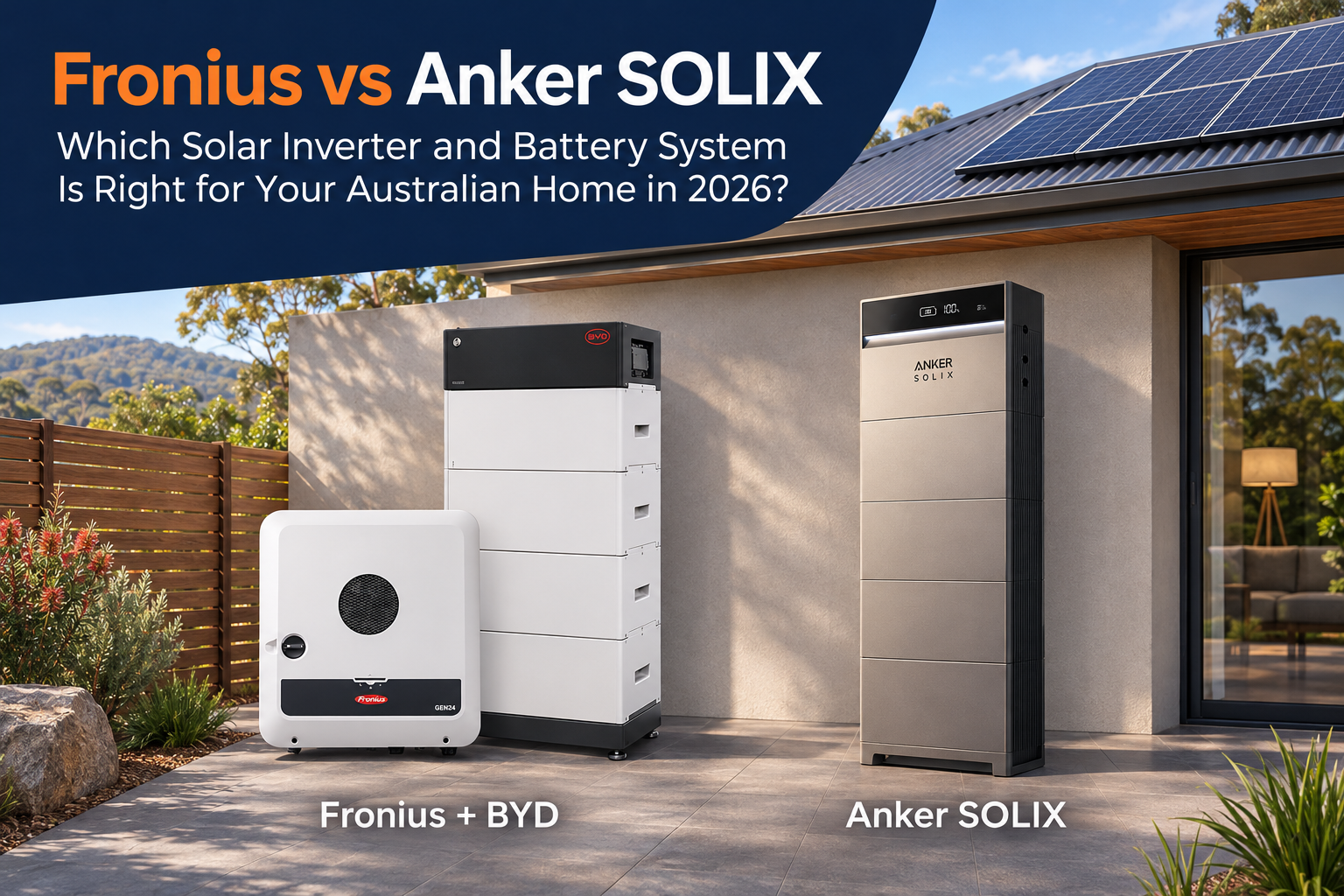
Fronius vs Anker SOLIX at a Glance
Fronius is a premium solar inverter brand with a 25-year Australian track record. Anker SOLIX is a fast-growing energy storage brand offering modular home batteries with integrated inverter options. The two are not always direct rivals. A household may keep its Fronius solar inverter and add an Anker SOLIX battery through AC coupling, subject to system compatibility.
| Category | Fronius | Anker SOLIX |
|---|---|---|
| Core product | String and hybrid solar inverters (Primo, Symo, GEN24 Plus) | Modular home battery with built-in inverter (X1, XE) |
| Australian history | In market since 1999, local office since 2010 | Commercially available since October 2024 |
| CEC approval | Fully listed across the current inverter range | X1 series is CEC listed; newer XE model was in the approval process as of mid-2026 |
| Standard warranty | 5 years standard, extendable on most models | 10 years on the X1 battery range |
| Typical price position | Premium, roughly $300 to $500 above mid-range brands | Competitive, positioned to suit the tiered federal rebate |
Brand Background and Track Record
Fronius: Three Decades of Inverter Engineering
Fronius was founded in Austria in 1945 and built its early reputation in welding technology before moving into solar power electronics in the early 1990s. Fronius opened a dedicated Australian office in Melbourne in 2010 and Fronius solar inverter systems have now been installed on Australian roofs for more than 25 years. That local presence matters because warranty claims, spare parts and technical support are handled through an established Australian network rather than routed overseas. You can read more about the company directly on the official Fronius Australia site.
Anker SOLIX: A Consumer Electronics Brand Enters Home Storage
Anker built its global name in phone chargers and portable power banks before creating the SOLIX division for home energy storage. The Anker SOLIX X1 home battery officially launched in Australia in April 2025 and has since become commercially available nationwide through distributors including One Stop Warehouse and Blue Sun Group. In May 2026 the brand unveiled the SOLIX XE, a more compact unibody battery and inverter designed around the tiered Cheaper Home Batteries Program, which was still moving through Clean Energy Council listing at the time of writing. Full specifications sit on the official Anker SOLIX Australia page.
What Each Brand Actually Sells: Inverter vs Battery Architecture
Understanding the inverter types makes this comparison easier. Fronius offers both standard solar inverters and hybrid inverters. The original Primo and Symo string inverters convert DC electricity from solar panels into AC electricity for the home. They do not connect directly to a battery. The GEN24 Plus is a hybrid inverter that can connect to a compatible DC-coupled battery such as a BYD Battery-Box.
Primo, Symo and GEN24 explained
Primo identifies Fronius single-phase inverters. Symo identifies three-phase inverters. The right type depends on your home’s electricity supply.
GEN24 is an inverter family available in both Primo and Symo versions. GEN24 Plus has battery connectivity enabled. A standard GEN24 can gain this function through the Fronius UP.storage software upgrade. These are inverter names, not battery names.
Anker SOLIX approaches the problem from the opposite direction. The X1 is a modular whole-home battery built from 5 kWh LFP modules, available in 15, 20, 25 and 30 kWh configurations, with a built-in inverter and Power Dock Pro for AC coupling to an existing solar system. The newer XE model goes a step further, combining two 7 kWh battery units and a 5 kW inverter in a single enclosure with wireless metering, removing the need for external CT clamp wiring.
In practice, a household is not always choosing one brand over the other. Many retrofits pair an existing Fronius inverter with an AC-coupled Anker SOLIX battery, while new installs might use a Fronius GEN24 Plus on its own or an Anker SOLIX system as a complete package.
- Original Fronius Primo and Symo: string inverters without a direct battery connection; storage can be added through a compatible AC-coupled system
- Fronius GEN24 Plus: hybrid inverter that connects to compatible DC-coupled batteries; backup options depend on the model and installation
- Anker SOLIX X1: modular AC-coupled battery with built-in inverter, single-phase and three-phase options
- Anker SOLIX XE: unibody battery plus 5 kW inverter, simplified wiring for faster installation
Performance, Efficiency and Build Quality
Fronius GEN24 Plus inverters use a smart shade mitigation algorithm that keeps drawing maximum output even when part of an array is shaded by a chimney, tree or neighbouring roofline. Dual MPPT trackers, active cooling and an IP66-rated enclosure are standard, and the SnapINverter mounting system lets an installer swap a failed component such as a fan or communication module without replacing the entire unit. This is one reason experienced installers consistently rank Fronius near the top of reliability surveys.
Anker SOLIX batteries use LiFePO4 (LFP) cell chemistry rated for more than 6,000 charge cycles. Their IP66-rated housing is designed for temperatures from minus 20 to 55 degrees Celsius. The slim 15-centimetre profile and app-based monitoring suit installations in garages, carports and on outdoor walls. With the appropriate inverter configuration, the battery can be added to an existing solar system without replacing its solar inverter.
Warranty and Local Support
Fronius offers a standard 5-year product warranty on its Australian inverter range, with extension options on many models. This is backed by more than a decade of local repair and technical support. Anker SOLIX backs its X1 battery range with a 10-year warranty. Its Australian installer network and warranty claims history are still relatively young. Our team can walk you through current warranty terms for both brands when you request a free quote.
Pricing in Australia: What You Will Actually Pay
A typical Fronius Primo, Symo or GEN24 Plus installation runs from roughly $2,000 to $3,500 installed for common single-phase residential models, after the federal STC discount. That sits around $300 to $500 above mid-range brands such as Sungrow or GoodWe, a premium most installers attribute to longer service life and a lower long-term failure rate.
Anker SOLIX X1 pricing varies by configuration. The 15, 20, 25 and 30 kWh options suit different household storage needs and receive different levels of support under the tiered Cheaper Home Batteries Program. You can compare indicative battery pricing across common capacities on our 10kWh solar battery price and 20kWh solar battery price pages. To compare a complete system, visit our 6.6kW solar and battery package page.
Rebate Eligibility and Compliance in 2026
Whichever brand you choose, eligibility for government support comes down to two things: the product must sit on the Clean Energy Council approved products list, and the system must be installed by a CEC accredited installer. Under the current Small-scale Renewable Energy Scheme rules, only listed inverters and batteries generate Small-scale Technology Certificates, which is what makes the Cheaper Home Batteries Program rebate possible in the first place.
Since 1 May 2026, the federal battery rebate has run on a tiered structure rather than a flat rate. The Small-scale Technology Certificate factor sits at 6.8 per kWh for installations completed between May and December 2026, applied as follows:
- 100 percent of the STC factor on the first 14 kWh of usable battery capacity
- 60 percent of the STC factor on capacity between 14 kWh and 28 kWh
- 15 percent of the STC factor on capacity between 28 kWh and 50 kWh
The tiered structure makes it important to size a battery around your household's needs rather than defaulting to the largest available option. You can check your household's eligibility and estimated savings on our solar rebate page. Our feed-in tariffs guide explains how export payments affect the payback calculation.
It is worth checking the live Clean Energy Council list before signing any contract. Product listings change, and a newly released model such as the Anker SOLIX XE may not be approved on the exact date you are ready to install, even if it is expected to be listed shortly afterwards.
Fronius vs Anker SOLIX: Which Should You Choose?
There is no single winner in the Fronius vs Anker SOLIX comparison because the products often serve different purposes. Use the guide below as a starting point, then talk to an accredited installer about your roof, energy use and budget.
Choose Fronius if you want:
- A solar inverter from a brand with a long track record in Australia
- Shade management for roofs affected by partial shading
- An established local warranty and repair network
- A single-phase or three-phase GEN24 model with the option to activate battery connectivity later through a software upgrade
Choose Anker SOLIX if you want:
- A modular battery that can retrofit onto an existing solar inverter without a full system replacement
- Fast installation with simplified wiring, particularly with the newer XE model
- A battery sized deliberately to sit within the highest rebate tier
- A sleek, compact unit for garages, carports or tight wall space
Frequently Asked Questions
Is Anker SOLIX CEC approved in Australia?
The Anker SOLIX X1 range, including its AC-coupled, single-phase and three-phase hybrid configurations, is listed on the Clean Energy Council approved products list. Newer models, such as the SOLIX XE, go through the same approval process before they can generate STCs, so always confirm the exact model number is currently listed before signing a contract.
Can I pair a Fronius inverter with an Anker SOLIX battery?
Often, yes. Because the Anker SOLIX X1 includes its own inverter electronics and connects via AC coupling, it can generally retrofit onto an existing Fronius string inverter system without replacing the inverter. An accredited installer will confirm compatibility for your specific setup.
Which is cheaper, Fronius or Anker SOLIX?
Fronius inverters sit in the premium price bracket, typically $300 to $500 above mid-range competitors. Anker SOLIX battery pricing varies by capacity and configuration. The rebate tiers can also affect the final cost. A direct dollar-for-dollar comparison is not meaningful unless the quotes cover the same equipment and installation scope.
Do I need a hybrid inverter to add battery storage?
Not necessarily. A hybrid inverter such as the Fronius GEN24 Plus is one way to add storage, but AC-coupled batteries such as the Anker SOLIX X1 are designed to work alongside a standard string inverter instead. Browse our full solar battery range or check our solar FAQs for more detail on how coupling works.
The Bottom Line
Fronius and Anker SOLIX offer different strengths for Australian homes. Fronius has an established solar inverter range and local support network. Anker SOLIX offers modular battery storage with options for adding storage to an existing solar system. The right choice depends on your current equipment, electricity use and storage needs. In some homes, a compatible combination of the two brands may be suitable.
Ready to compare options for your home? Get a free, no-obligation quote from Smart House Solar. Our team will help you work out whether a Fronius inverter, an Anker SOLIX battery or a combination of the two suits your household.

 Call Now
 Whatsapp
 Download Packages