



Electricity prices in Australia keep climbing, and more homeowners are asking the same question: is a solar battery finally worth it in 2026? The short answer is yes, and the timing has never been better. Between falling battery prices, smarter energy management technology, and the federal government's Cheaper Home Batteries Program, 2026 has become one of the strongest years on record for home battery storage.
This guide breaks down the best solar batteries in Australia for 2026, what actually matters when comparing them, and how to work out the right size and system for your home. Whether you are searching for the best solar battery Australia has to offer for a small household or a 10kW solar battery price in Australia for a larger home, this guide covers it.
Why 2026 Is a Turning Point for Home Battery Storage
Rooftop solar has been mainstream in Australia for well over a decade, but a large share of that solar energy has historically gone unused. Without storage, excess daytime generation is exported to the grid at low feed-in rates, and households still pay full price for grid electricity at night. A solar battery closes that gap by storing your own solar power for use after sunset, during peak tariff periods, or during a blackout.
Three things have shifted the economics in 2026:
- The Cheaper Home Batteries Program. Since 1 July 2025, the federal government has offered a rebate through the Small-scale Renewable Energy Scheme (SRES) that cuts the upfront cost of an eligible battery by roughly 30 percent. The rebate is delivered as Small-scale Technology Certificates (STCs), applied directly by your installer at purchase, so there is no separate claim or paperwork. The rate steps down gradually each year, so the value available in 2026 is higher than what households will see from 2027 onward.
- Falling hardware costs. A typical 10kWh battery that cost $10,000 to $15,000 installed a few years ago now often lands in a lower bracket once the rebate is applied, depending on brand, inverter compatibility, and installation complexity.
- Smarter batteries. AI-driven energy management, virtual power plant (VPP) participation, and tighter inverter-battery integration mean today's systems do more than store energy. Many now actively manage when to charge, discharge, or export based on real-time tariff signals.
If you want to check exactly how much you could save under the current scheme, our solar rebate page has a full breakdown of eligibility and current rebate values for Australian households.
What to Look for in a Solar Battery
Not every battery on the market is a good fit for every home, and price alone should never be the deciding factor. Before comparing specific brands, it helps to understand the criteria that actually separate a good battery from a mediocre one.
- Battery chemistry. Most reputable installers now favour Lithium Iron Phosphate (LFP) chemistry over older nickel manganese cobalt (NMC) cells. LFP batteries tolerate Australian heat better and generally offer a longer cycle life with a stronger safety record.
- Usable capacity versus nominal capacity. A battery's advertised capacity is not always what you can use. Usable capacity accounts for the depth of discharge the manufacturer allows, so always compare usable kWh, not just the headline number.
- Round-trip efficiency. This measures how much energy you get back out compared to what you put in. Look for efficiency above 90 percent, as anything lower wastes more solar generation as heat during charging and discharging.
- Warranty and cycle life. Most quality batteries now carry 10-year-plus warranties, often backed by a guaranteed cycle count or a minimum retained capacity at the end of the warranty term, commonly 60 to 70 percent.
- Backup and blackout capability. Not every battery and inverter combination supports whole-home or partial backup during an outage. Confirm this before purchasing, since it usually requires an additional backup gateway or compatible hybrid inverter.
- CEC-approved hardware and SAA-accredited installer. Two separate checks apply, and both matter. The battery and inverter must appear on the Clean Energy Council's (CEC) approved products list, since CEC still maintains those hardware lists. Separately, the person designing and installing the system must hold current accreditation with Solar Accreditation Australia (SAA), which took over installer and designer accreditation from the CEC in 2024. Confirm both before signing a contract, as missing either one disqualifies the rebate entirely.
- Scalability. Many modern systems, including Sigenergy's SigenStor and Alpha ESS units, are modular, so you can add battery packs later as your needs grow rather than replacing the whole system.
Top Solar Battery Brands in Australia for 2026
Here is how the leading brands compare based on real-world installations, warranty terms, and suitability for Australian homes.
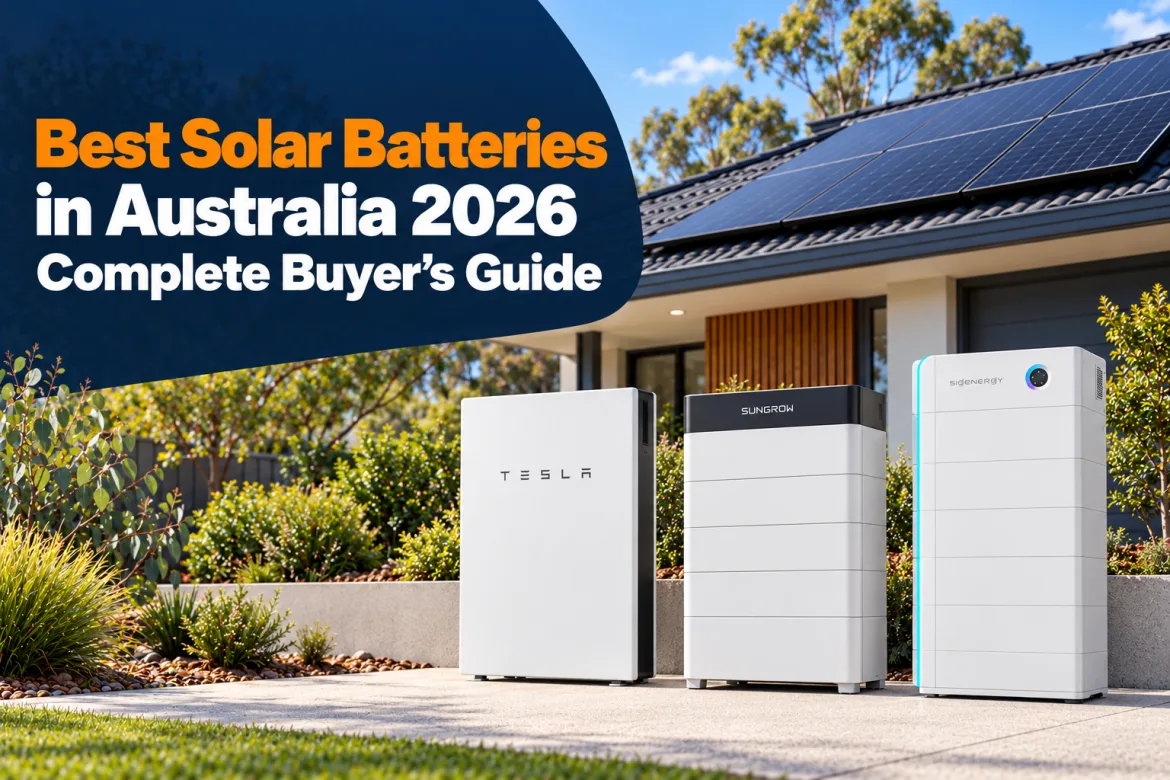
Tesla Powerwall 3
The Powerwall 3 remains one of the most recognised home batteries in the country. It combines 13.5kWh usable capacity with a built-in hybrid inverter rated up to 11.5kW, so it can pair directly with new or existing solar arrays without a separate inverter in many cases. It carries a 10-year warranty, IP67 weather protection, and qualifies for the Cheaper Home Batteries Program, which brings the effective installed price down substantially. It suits households wanting a proven, widely supported system with strong app-based monitoring.
Sungrow SBR and SBH Series
Sungrow is one of the most widely installed battery brands in Australia, known for reliability at a competitive price point. The SBR and SBH series are modular LFP systems that scale from around 9.6kWh up to over 25kWh by adding battery modules, making them practical for households wanting to expand storage later. Sungrow batteries pair well with Sungrow hybrid inverters for a fully integrated system, detailed on our Sungrow inverter page.
Sigenergy SigenStor
Sigenergy has quickly become one of the most talked-about battery brands in Australia. SigenStor uses AI-powered energy management to automatically optimise when the battery charges, discharges, or exports based on tariff data and usage patterns. It is a modular, all-in-one system combining inverter, battery, and EV charging capability in some configurations, appealing to homeowners wanting a future-ready setup with maximum control.
Alpha ESS
Alpha ESS batteries are a strong mid-range option with a solid reliability record across Australian installations. The stackable design lets homeowners start smaller and expand capacity later without replacing existing hardware. For current pricing, see our Alpha ESS battery price page.
GoodWe Lynx and Enphase IQ Battery
GoodWe's Lynx series offers dependable LFP storage at a competitive price and integrates well with GoodWe hybrid inverters. Enphase takes a different approach with its IQ Battery, built around a distributed, microinverter-style design that some installers favour for homes with complex roofs or partial shading.
How Much Battery Capacity Does Your Home Actually Need?
Sizing is where many households go wrong, either overspending on capacity they will never use or undersizing and missing out on overnight savings. As a general guide:
- Small households (1 to 3 people) typically get strong value from a battery in the 5kWh to 6kWh range. See our 6kW solar battery cost page for pricing.
- Average family homes (3 to 4 people) are commonly matched with 10kWh to 13kWh systems. Check our 10kW solar battery price in Australia and 13kW solar battery price pages.
- Larger homes wanting extended blackout backup often look at 15kWh to 20kWh, covered on our 15kW and 20kW solar battery price pages.
- Commercial or light industrial sites frequently need 30kWh to 40kWh or more, detailed on our 30kW and 40kW solar battery price pages.
A common and cost-effective pairing for Australian homes is a 6.6kW to 10kW rooftop solar system matched with a 10kWh to 14kWh battery, which typically covers evening usage for a family household while leaving room to export surplus energy back to the grid. Check our feed-in tariffs page to see how export rates factor into the overall payback period in your area.
Understanding the Cheaper Home Batteries Program in 2026
The federal Cheaper Home Batteries Program has become the single biggest factor driving battery uptake this year. Here is what households need to know:
- The rebate applies to systems between 5kWh and 100kWh in nominal capacity, though STCs are only generated for the first 50kWh of usable capacity.
- Eligible systems must be installed by an SAA-accredited installer or designer, using a battery and inverter listed on the Clean Energy Council's approved products list.
- There is no means test, so eligibility is not based on household income.
- The battery must be paired with a rooftop solar system, whether newly installed or already in place.
- The rebate value steps down periodically, so the discount available in 2026 is meaningfully higher than what is expected from 2027 onward.
- In several states, the federal rebate can be stacked with state-based incentives or virtual power plant payments for further savings.
Because rebate values are adjusted periodically throughout the scheme, it is worth confirming the current rate directly with your installer or checking the Department of Climate Change, Energy, the Environment and Water's official program page before finalising a quote. You can also review the Clean Energy Council's approved battery list to confirm your chosen system qualifies, and the Clean Energy Regulator's guidance on how STCs are calculated under the SRES.
It is worth noting that CEC and SAA now play distinct roles in this process. The Clean Energy Council still maintains the approved product lists for panels, inverters, and batteries, so hardware eligibility is checked against CEC's lists. Installer and designer accreditation, however, moved to Solar Accreditation Australia in 2024. Only an SAA-accredited installer can legally claim STCs on your behalf, so it is worth asking any installer for their current SAA accreditation number rather than assuming older references to “CEC-accredited installers” still apply.
Battery Backup and Blackout Protection
One benefit that often gets overlooked is blackout resilience. Most modern batteries can supply power during an outage, but only when paired with a compatible hybrid inverter or a dedicated backup gateway. Depending on the configuration, backup can cover essential circuits such as fridges, lighting, and internet, or the entire home. If backup power matters to your household, particularly in cyclone-prone parts of Queensland, confirm this capability before purchasing, as not every battery model supports full backup out of the box.
Getting the Right System for Your Home
The battery brand matters, but the overall system design matters more. Two identical batteries can deliver very different results depending on how the solar array, inverter, and battery are sized and configured together. Quotes based on rough averages rather than actual household energy data often lead to the wrong system size, either leaving savings on the table or paying for capacity that never gets used.
At Smart House Solar, our consultants assess your actual energy usage, roof orientation, and household patterns before recommending a system, rather than defaulting to a one-size-fits-all package. We work with a wide range of CEC-approved brands, including Tesla, Sungrow, Sigenergy, Alpha ESS, and GoodWe, and our installations are carried out by SAA-accredited installers and designers, so both your hardware and your installer meet the requirements for government rebates.
Frequently Asked Questions
What is the best solar battery in Australia right now?
There is no single best battery for every household. Tesla Powerwall 3 suits homeowners wanting an established, widely supported system. Sigenergy suits those wanting advanced AI-driven energy management. Sungrow and Alpha ESS offer strong value for households prioritising reliability and expandability.
How much does a solar battery cost in Australia in 2026?
Costs vary by brand, capacity, and installation complexity, and the Cheaper Home Batteries Program materially reduces the upfront price for eligible systems. Get a personalised quote through our contact page for accurate, current pricing based on your home.
Do I need a new solar system to add a battery?
Not necessarily. Many batteries can be retrofitted to an existing solar system, provided the existing inverter and panels meet current safety and compatibility requirements. Our guide on adding a battery to an existing solar system covers what to check first.
Are all solar batteries eligible for the government rebate?
No. The battery and inverter must be listed on the Clean Energy Council's approved products list, and the system must be installed by an installer or designer holding current Solar Accreditation Australia (SAA) accreditation. Both conditions need to be met for the Cheaper Home Batteries Program rebate to apply. Our guide on who is eligible for the federal battery rebate goes through the full checklist.
Final Thoughts
2026 is shaping up as one of the best years in recent memory to invest in home battery storage in Australia, driven by a substantial federal rebate, more capable battery technology, and rising grid electricity costs. Whether you are comparing the best solar battery in Australia for a small unit or planning a larger commercial system, the right choice comes down to matching capacity, chemistry, and warranty terms to your actual household needs rather than chasing the most hyped brand.
If you are ready to compare options and see what rebate you qualify for, get in touch with the Smart House Solar team for a free, obligation-free quote tailored to your home.
Get in touch with Smart House Solar
Call 1300 650 747, email info@smarthousesolar.com.au, or visit our contact page to book your free consultation. Smart House Solar serves homeowners and businesses across Queensland and Western Australia, with offices at Level 38, 71 Eagle Street, Brisbane, and Level 27, St Martins Tower, 44 St Georges Terrace, Perth.


 Call Now
 Whatsapp
 Download Packages