



The federal Cheaper Home Batteries Program applies to eligible batteries installed on new or existing rooftop solar systems. You don't need to replace your existing panels or purchase a brand-new solar package to access the discount. However, several eligibility requirements apply: the battery must be new and listed on the Clean Energy Council (CEC) approved battery list, comply with AS/NZS 5139:2019, and be capable of participating in a Virtual Power Plant (VPP). The installation must also be carried out by an appropriately accredited installer with the required battery endorsement. Only one battery system per premises can receive the discount.
If you already went solar a few years ago and are now watching your export credits shrink while your evening electricity bill climbs, this is genuinely good news. Adding a battery to an existing solar system is one of the most common upgrades homeowners are making in 2026, and here's exactly how the rebate works with an existing system, what needs to check out first, and how much you can expect to save.
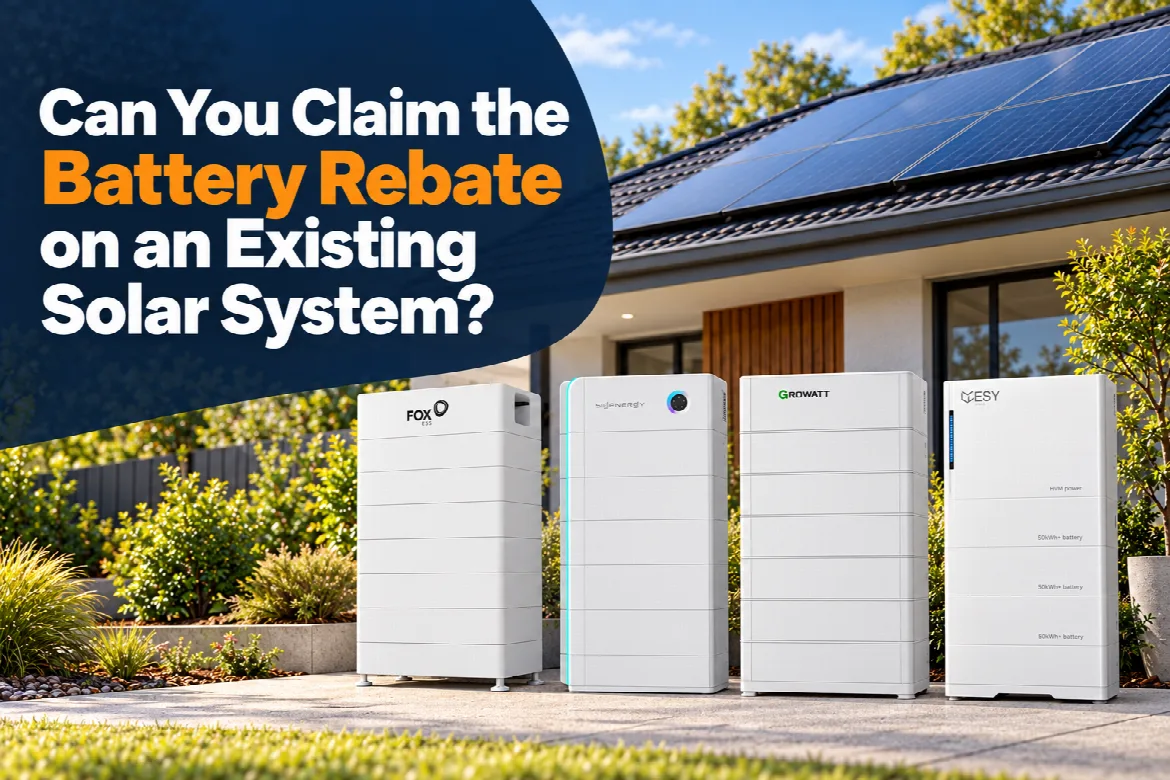
What Is the Cheaper Home Batteries Program?
The Cheaper Home Batteries Program is the Australian Government's national battery incentive, running since 1 July 2025. It's delivered as a point-of-sale discount, not a rebate you claim after the fact, worth roughly 30% off the upfront cost of an eligible battery system between 5kWh and 100kWh in nominal capacity.
Rather than a cash-back cheque, the discount is applied through Small-scale Technology Certificates (STCs) under the Small-scale Renewable Energy Scheme (SRES). Your solar and battery retailer calculates the STC value for your battery and deducts it straight from your quote, so you never have to chase a rebate through a government portal yourself.
The program is administered by the Department of Climate Change, Energy, the Environment and Water (DCCEEW) and overseen by the Clean Energy Regulator (CER). You can view the official eligibility criteria on the energy.gov.au rebates page.
So, Does It Apply If I Already Have Solar Panels?
Yes, and this is written explicitly into the program design. DCCEEW confirms the discount covers batteries "connected to new or existing rooftop solar," meaning retrofitting a battery onto a system you installed years ago is treated the same as installing solar and a battery together for the first time.
In fact, most battery installations happening across Australia right now are retrofits. If you've had solar for a while, adding a battery to an existing solar system is usually the single biggest upgrade you can make to your setup, since it lets you store the excess energy your panels are already generating during the day and use it once the sun goes down, instead of exporting it for a few cents per kWh and buying it back at night for 30 cents or more.
Eligibility Requirements for Adding a Battery to Existing Solar
Before your existing system qualifies for the rebate, a few boxes need to be ticked:
1. Your inverter needs to be CEC-listed
If you're adding a battery to an existing solar PV system, the existing solar panels do not need to appear on the Clean Energy Council's approved product list. The requirement applies to the hybrid inverter that the new battery is connected to. That inverter must meet the applicable CEC requirements. If the inverter has been formally delisted for safety or compliance reasons, the battery system may not be eligible; an older model that is no longer sold is a different situation and may still qualify.
2. Your system must meet current electrical safety standards
Older installations sometimes need minor compliance work, such as updated isolators, switchboard upgrades, or earthing adjustments, to meet current state and territory electrical safety regulations before a battery can be safely connected.
3. The battery itself must sit within the eligible size range
Eligible systems range from 5kWh to 100kWh of nominal battery capacity, although STCs are only available for the first 50kWh of new or additional usable battery capacity. Each battery must independently meet the minimum 5kWh capacity requirement; smaller batteries cannot be combined or "stacked" to reach the 5kWh minimum.
4. Installation must be by an accredited installer
Your battery must be installed and commissioned by an installer using an SAA (Solar Accreditation Australia) Accredited Electrician, in accordance with the applicable accreditation and installation requirements.
At Smart House Solar, our installers are SAA accredited and we handle this compliance check as a standard part of every retrofit quote, so you're not left guessing whether your existing panels and inverter will pass. For the full federal criteria in one place, see our guide to who is eligible for the federal battery rebate.
How Much Is the Rebate Worth in 2026?
The discount is calculated based on the usable battery capacity, with different STC rates applying to different portions of the battery. From 1 May 2026, batteries up to 14kWh receive 100% of the applicable STC rate, the portion between 14kWh and 28kWh receives 60%, and the portion between 28kWh and 50kWh receives 15%. The STC factor is currently 6.8 and is scheduled to fall to 5.7 on 1 January 2027. With that change only three months away, installing sooner can mean a higher STC incentive, subject to the system's eligibility and installation date.
There's no income test and no application form to fill in. Your retailer calculates your entitlement automatically and reflects it in your final invoice. You can estimate your own STC entitlement using the REC Registry's small generation unit STC calculator, run by the Clean Energy Regulator.
For indicative dollar figures by battery size, see our breakdown of how much battery rebate you can get in 2026.
Can I Stack State and Federal Rebates on an Existing System?
Depending on where you're located, yes, and this matters a lot if you're in Queensland or Western Australia, where Smart House Solar operates out of Brisbane and Perth.
Queensland: The state's former Battery Booster rebate stopped accepting new applications in May 2024. QLD households, including homeowners searching for a battery rebate in Brisbane, now rely solely on the federal Cheaper Home Batteries Program, but strong solar generation across South East Queensland and regional QLD means the federal discount alone still makes retrofitting a battery worthwhile for most existing solar owners.
Western Australia: The WA Residential Battery Scheme, run through Synergy and Horizon Power, was deliberately designed to stack on top of the federal rebate. Synergy customers, including most Perth households, can access up to $1,300 (based on $130 per usable kWh, capped at 10kWh), while Horizon Power customers in regional WA can access up to $3,800 ($380 per usable kWh, capped at 10kWh). Unlike the federal program, the WA scheme requires you to actually enrol in an approved VPP, such as Synergy Battery Rewards, for at least two years to receive the rebate. The WA Government also notes that adding a battery to an existing solar system can sometimes require extra equipment or reconfiguration, so a site assessment is essential before quoting.
Because state-level programs change and some (like Victoria's and South Australia's former battery rebates) have already closed, it's worth confirming current settings before assuming a state top-up applies. Your installer should verify this at quoting stage rather than relying on older articles.
Steps to Claim the Rebate on Your Existing Solar System
- Get your existing system assessed. An SAA accredited installer checks your inverter, switchboard, and wiring against current safety requirements and the CEC approved product list.
- Choose a correctly sized battery. Oversizing a battery for an undersized inverter limits how much benefit you actually get. Sizing should reflect your daily usage and your panels' output, not just the biggest battery on the shelf.
- Get a written, itemised quote. The STC discount should be shown as a line-item deduction, not folded vaguely into a "special price."
- Confirm VPP-capable hardware, even if you don't plan to join a VPP immediately. This protects your eligibility and keeps future options open.
- Have the battery installed and commissioned by an accredited installer who is physically on-site for the job.
If you'd like this handled end-to-end, our team can check your existing solar and inverter, confirm what rebate applies to your address, and provide an obligation-free quote with the discount already built in.
Frequently Asked Questions
Do I need to buy new solar panels to get the battery rebate?
No. The rebate is specifically available for batteries added to existing rooftop solar, provided your inverter and electrical setup meet current standards.
Can I get the battery rebate if I already have solar?
Yes. This is the most common scenario the program supports. As long as your existing solar system and inverter meet current safety and CEC compatibility requirements, you're eligible for the same discount as someone installing solar and a battery together for the first time.
Is the battery rebate a cash payment?
No. It's applied as a point-of-sale discount on your invoice through STCs, calculated by your retailer at the time of purchase. There's no separate cheque or reimbursement process.
What if my inverter isn't compatible with a new battery?
Some older or entry-level inverters aren't hybrid-capable, meaning you may need an AC-coupled battery (which pairs with your existing inverter) or, in some cases, an inverter upgrade. This is assessed during your site inspection.
Does the battery rebate reduce with a bigger battery?
Yes, since 1 May 2026, the discount rate applies in full up to 14kWh, then tapers for capacity above that. Bigger doesn't always mean a proportionally bigger discount.
Can I install a battery without solar and still get the rebate?
The battery still needs to be connected to rooftop solar (new or existing). The program is designed around solar-plus-storage, not stand-alone battery installs disconnected from generation.
Is the rebate means-tested?
No. Unlike some earlier state schemes, the federal Cheaper Home Batteries Program has no income test. It's available to eligible households and small businesses Australia-wide.
How do I know what size battery suits my existing solar system?
This comes down to your daily electricity usage, your solar system's output, and your inverter's capacity. Our solar battery range covers several sizes, and our consultants can recommend the right fit based on your household.
Ready to Add a Battery to Your Existing Solar?
If your panels have been on your roof for a few years and you're tired of watching cheap daytime solar go to waste, adding a battery to your existing solar system with the federal discount applied is usually the fastest payback upgrade available to existing solar owners. Check our current solar rebate information, compare it against your current feed-in tariff, or browse more answers on our Solar FAQs page.
For a free assessment of your existing system's eligibility and a no-obligation quote, get in touch with Smart House Solar or call 1300 650 747.
General Disclaimer: Information on this website is for general information purposes only and is current as at 2 October 2026. Incentives, eligibility requirements, regulations and product availability may change. Eligibility, savings and payback periods vary by individual circumstances and are not guaranteed. Please confirm current requirements and your eligibility before making a purchase or installation decision.


 Call Now
 Whatsapp
 Download Packages